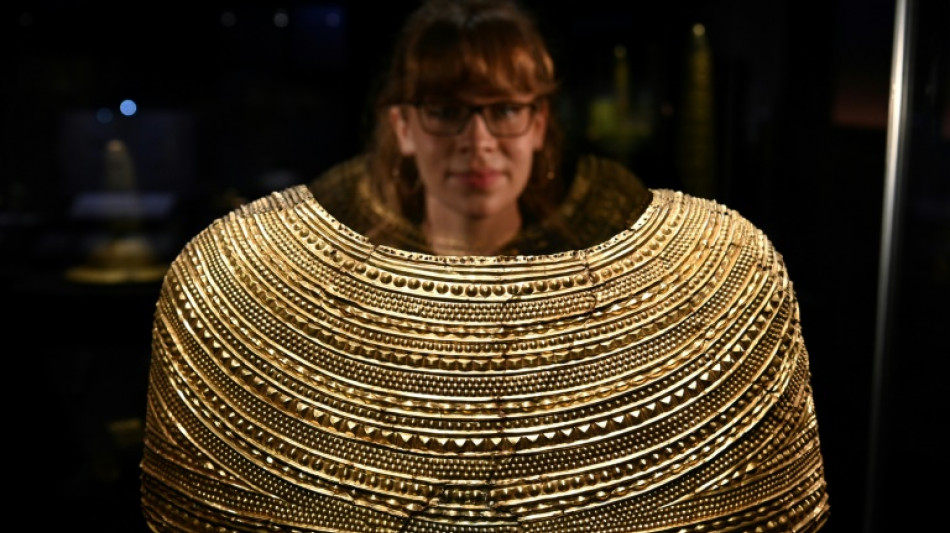
British Museum exhibition traces rise and fall of Stonehenge / Photo: ©

 Inter Milan go top in Italy as champions Napoli stumble

 World leaders express horror at Bondi beach shooting

 Guardiola hails Man City's 'big statement' in win at Palace

 No 'quick fix' at Spurs, says angry Frank

 Freed Belarus protest leader Kolesnikova doesn't 'regret anything'

 Arshdeep helps India beat South Africa to take T20 series lead

 'Outstanding' Haaland stars in win over Palace to fire Man City title charge

 Napoli stumble at Udinese to leave AC Milan top in Serie A

 Haaland stars in win over Palace to fire Man City title charge

 'Golden moment' as Messi meets Tendulkar, Chhetri on India tour

 Far right eyes comeback as Chile presidential vote begins

 Devastation at Sydney's Bondi beach after deadly shooting

 Person of interest in custody after deadly shooting at US university

 Zelensky in Berlin for high-stakes talks with US envoys, Europeans

 Hong Kong's oldest pro-democracy party announces dissolution

 Zelensky says will seek US support to freeze front line at Berlin talks

 Wonder bunker shot gives Schaper first European Tour victory

 Gunmen kill 11 during Jewish event at Sydney's Bondi Beach

 France's Bardella slams 'hypocrisy' over return of brothels

 Shooting at Australia's Bondi Beach kills nine

 Thailand confirms first civilian killed in week of Cambodia fighting

 Police hunt gunman who killed two at US university

 McCullum admits England have been 'nowhere near' their best

 Cambodia-Thailand border clashes enter second week

 Green says no complacency as Australia aim to seal Ashes in Adelaide

A new exhibition on the Stonehenge stone circle in southern England sheds new light on its 4,500-year history, linking its declining influence to the Bronze Age population's discovery of metal working.
Opening Thursday at the British Museum in London, the exhibition called "The World of Stonehenge" traces the development of the UNESCO-protected site -- two concentric circles of huge stone blocks and lintels.
According to Celtic legends of the Middle Ages, the circle was magically created by the mythical magician Merlin.
Construction at the site was started during the Neolithic era by hunter-gatherers without metal tools and continued into the Bronze Age as metal working became widely established.
European metal workers arrived during the early Bronze Age, gradually superseding the local Neolithic population.
"Within a couple of hundred years, those people from Europe replaced the previous population by almost 95 percent," Neil Wilkin, the exhibition's curator, said.
As their culture and beliefs became dominant, Stonehenge lost its original purpose and became used as a cemetery, he added.
The exhibition shows numerous tombs from the time, as well as objects such as large gold necklaces made in France around 2300 BC.
The Nebra Sky Disc, the world's oldest surviving map of the stars, smelted in gold and bronze in 1600 BC in present-day Germany, is also featured.
Altogether there are more than 430 objects from the United Kingdom, Ireland, France, Germany, Denmark and Switzerland at the exhibition, which runs to July 17.
The British Museum also displays 14 wooden poles that were preserved for millennia under the sand of a beach in Norfolk, eastern England, until their discovery in 1998.
These are the remains of a wooden circle called Seahenge, on loan to the museum for the first time.
The 4,000-year-old circle once featured 54 oak piles arranged in a circle 6.6 metres in diameter, with a huge upturned tree in the centre, its roots facing skywards.
This circle would have been used for rituals in a similar way to Stonehenge, but was built five centuries later (2049 BC), using metal axes typical of the Bronze Age, said Wilkin, as the tradition of building such circles dwindled away.
"Seahenge is one of the last monuments of its type built in Britain. It's the very end of a long tradition that spans 1,000 years," he noted.
L.Dubois--BTB


