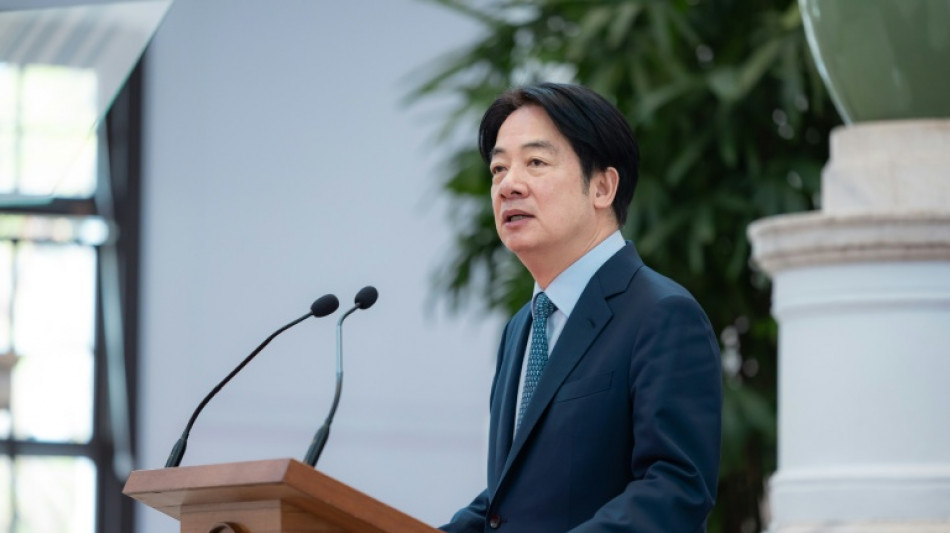
Taiwan exporters count the cost of Trump's 'ridiculous' tariffs / Photo: © TAIWAN PRESIDENTIAL OFFICE/AFP

 Far right eyes comeback as Chile presidential vote begins

 Devastation at Sydney's Bondi beach after deadly shooting

 Person of interest in custody after deadly shooting at US university

 Zelensky in Berlin for high-stakes talks with US envoys, Europeans

 Hong Kong's oldest pro-democracy party announces dissolution

 Zelensky says will seek US support to freeze front line at Berlin talks

 Wonder bunker shot gives Schaper first European Tour victory

 Gunmen kill 11 during Jewish event at Sydney's Bondi Beach

 France's Bardella slams 'hypocrisy' over return of brothels

 Shooting at Australia's Bondi Beach kills nine

 Thailand confirms first civilian killed in week of Cambodia fighting

 Police hunt gunman who killed two at US university

 McCullum admits England have been 'nowhere near' their best

 Cambodia-Thailand border clashes enter second week

 Green says no complacency as Australia aim to seal Ashes in Adelaide

 Higa becomes first Japanese golfer to win Asian Tour order of merit

 Deja vu? Trump accused of economic denial and physical decline

 China's smaller manufacturers look to catch the automation wave

 Hungary winemakers fear disease may 'wipe out' industry

 German defence giants battle over military spending ramp-up

 Quarterback Mendoza wins Heisman as US top college football player

 Campaigning starts in Central African Republic quadruple election

 Tokyo-bound United flight returns to Dulles airport after engine fails

 Salah back in Liverpool fold as Arsenal grab last-gasp win

 Glasgow comeback upends Toulouse on Dupont's first start since injury

Taiwanese exporters are crunching numbers and talking to American clients as they scramble to figure out how to respond to US President Donald Trump's tariff blitz that threatens to derail their businesses.
While the final impact is not yet known, factory owners on the island are clear eyed on one thing: moving operations to the United States is easier said than done.
"Taiwan's structure is what makes this industry viable," the owner of a machine tool exporter told AFP on the condition of anonymity, highlighting the island's network of small and medium-sized factories supplying his company.
"There are so many components, like gears, belts and others -- the US doesn't have these industries. Setting up a factory in the US would not be worth it," he said, describing Trump's policy as "ridiculous".
From Wednesday, Taiwanese products shipped to the United States, including electronics, machinery components, auto parts and bicycles, will be hit with a hefty 32 percent levy.
It is part of Trump's far-reaching global tariffs that have rocked world markets and sparked recession fears, as he seeks to reduce the US trade deficit and push companies to shift manufacturing to American soil.
Many in Taiwan were stunned by the size of the duty, after chipmaking titan Taiwan Semiconductor Manufacturing Co's plan to invest an additional $100 billion in the United States raised hopes the island would be spared.
While chips have so far avoided tariffs, analysts have warned the critical sector could be impacted anyway as levies drive up the cost of iPhones, laptops and other technology, and reduce consumer demand.
- 'Unsophisticated understanding' -
Taiwanese companies have spent days calculating the impact on their operations and speaking to US clients about how to absorb the cost of the new tariff.
"They've been receiving a lot of calls or instructions," said Kristy Hsu, director of the Taiwan ASEAN Studies Center at Chung-Hua Institution for Economic Research.
She told AFP that US customers have requested deliveries be postponed or prices lowered.
Companies were also trying to determine if their products contained at least 20 percent "American content", which could partially shield them from Trump's levy, she added.
During Trump's first term in office, US tariffs against China prompted many Taiwanese companies operating there to relocate to Southeast Asia to avoid the tax.
This time, however, there are fewer places to hide.
Trump has slugged imports from Vietnam and Thailand with 46 percent and 36 percent tariffs, respectively, and there was uncertainty about whether duties could be cut or raised even higher.
"Right now, the only option for setting up factories overseas is the United States, but the cost of doing so is extremely high," an official from an electronic industry group told AFP.
"This truly isn't something that can be done easily," she said, adding "we didn't expect the US would come down this hard."
Trump's across-the-board tariffs revealed an "unsophisticated understanding" of how supply chains worked, said Ho Ming-yen, non-resident fellow of the Research Institute for Democracy, Society and Emerging Technology.
- Levy 'impossible to absorb' -
Even if companies shifted their factories to the United States, they would still be slugged with tariffs on imported components needed for their products, Ho said.
Ho expected most Taiwanese companies would likely take a "wait-and-see" approach and cut costs as they "wait for the calamities to end".
Taiwan President Lai Ching-te said he had no plans for "retaliatory tariffs" against the United States, the island's most important security partner.
The government has pledged US$2.7 billion to help affected industries, but that was a "drop in the ocean" for what was needed, said Jason Hsu, senior fellow at the Hudson Institute think-tank.
Hsu estimated tariffs would cost Taiwanese exporters US$15 billion-US$20 billion a year.
To secure any relief from Trump, Taiwan needed to come up with deals for the president, said Hsu, a former member of Taiwan's legislature for the opposition Kuomintang party.
"Trump doesn't care about allies and partnerships, he cares about how much business you can bring to the US," Hsu said.
The machine tool exporter said the United States was a "very important market" for the company, accounting for 30-40 percent of its sales.
While the business would survive in the short term, the owner hoped Taiwan could strike a deal with Washignton.
"A four to five percent hike we can split (with our clients) and absorb," he said.
"But 32 percent is impossible to absorb. Our profit margin isn't that high."
M.Odermatt--BTB