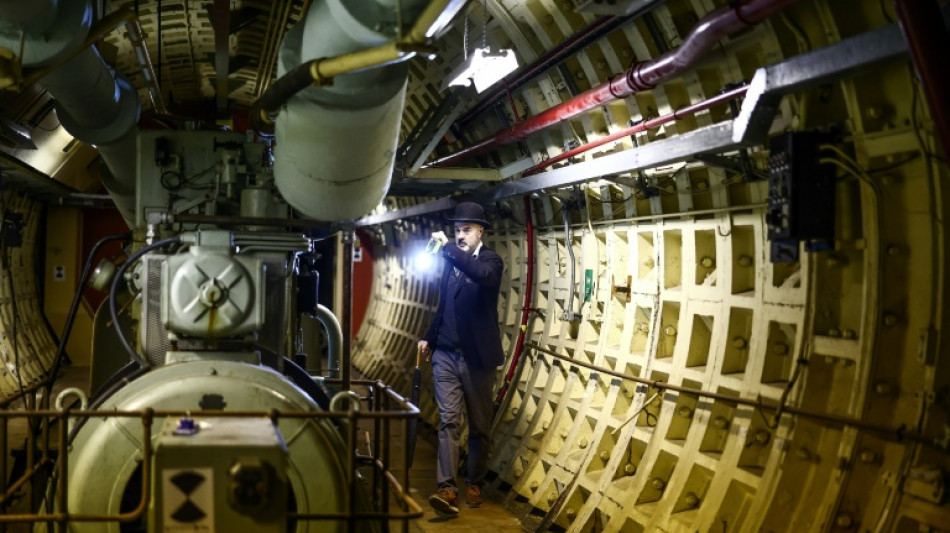
Ghosts of past spies haunt London underground tunnels / Photo: © AFP

 Devastation at Sydney's Bondi beach after deadly shooting

 Person of interest in custody after deadly shooting at US university

 Zelensky in Berlin for high-stakes talks with US envoys, Europeans

 Hong Kong's oldest pro-democracy party announces dissolution

 Zelensky says will seek US support to freeze front line at Berlin talks

 Wonder bunker shot gives Schaper first European Tour victory

 Gunmen kill 11 during Jewish event at Sydney's Bondi Beach

 France's Bardella slams 'hypocrisy' over return of brothels

 Shooting at Australia's Bondi Beach kills nine

 Thailand confirms first civilian killed in week of Cambodia fighting

 Police hunt gunman who killed two at US university

 McCullum admits England have been 'nowhere near' their best

 Cambodia-Thailand border clashes enter second week

 Green says no complacency as Australia aim to seal Ashes in Adelaide

 Higa becomes first Japanese golfer to win Asian Tour order of merit

 Deja vu? Trump accused of economic denial and physical decline

 China's smaller manufacturers look to catch the automation wave

 Hungary winemakers fear disease may 'wipe out' industry

 German defence giants battle over military spending ramp-up

 Quarterback Mendoza wins Heisman as US top college football player

 Campaigning starts in Central African Republic quadruple election

 Tokyo-bound United flight returns to Dulles airport after engine fails

 Salah back in Liverpool fold as Arsenal grab last-gasp win

 Glasgow comeback upends Toulouse on Dupont's first start since injury

 'Quality' teens Ndjantou, Mbaye star as PSG beat Metz to go top

Behind a blue door in a narrow London passage lies a little-known network of tunnels deep underground, once home to British spies and a secret long-distance telephone exchange.
Thirty metres (100 feet) below the UK capital's bustling streets, all that can be heard in the tunnels built to withstand a nuclear attack is the rumble of the London Underground's Circle Line.
The two main tunnels, five to seven metres in diameter, reached via some steps and then a lift, "were built to defend the British from the Nazis" during World War II, explained Angus Murray, on a guided visit for a small group of journalists.
The Australian-born entrepreneur's private equity firm bought the little-known Kingsway Exchange Tunnels in September 2023 from British Telecom. The price has not been divulged.
Now Murray hopes to transform the site, which stretches for over a mile (1.6 kilometres), into a major tourist attraction "honouring the history and heritage of London" with a planned opening in 2028.
The complex beneath the Holborn district was built as an air-raid shelter during the early 1940s bombardments known as the Blitz.
- Inspiration for 007 -
The site is now planned to host immersive displays showcasing its distinctive heritage as a World War II bomb shelter and then as the home of the top-secret Special Operations Executive between 1944 and 1945.
The Special Operations Executive was created by then prime minister Winston Churchill earlier in the war to support European resistance movements fighting occupation by Nazi Germany.
Separate from the MI6 foreign intelligence service, it is considered the inspiration for "Q Branch" in Ian Fleming's James Bond franchise.
After the war, the tunnels were used for storing official documents as well as a possible reserve shelter for war rooms, in case of further conflicts.
The UK government later enlarged the site in the 1950s at the start of the Cold War to host a secure long-distance telephone exchange, shrouding it in official secrecy for decades.
The first transatlantic telephone cable, called TAT-1, was operated from the tunnels, becoming a key cog in the so-called hotline between Moscow and Washington that emerged in the wake of the 1962 Cuban Missile Crisis.
In one of the rooms, visitors catch a glimpse of the large exchange and its plethora of plugs through which the operator could manually connect a caller with the person they were trying to reach.
"Because during the war some of the telecommunications exchanges got bombed, they needed a deep level telecommunications exchange," said Murray.
- Forgotten offices -
The site, spread over 8,000 square metres (86,000 square feet), accommodated up to 200 staff working deep underground far from any natural light. It also featured a bar, a restaurant with mock windows, and a recreational room with snooker tables.
But by the late 1980s, telecommunications technology had advanced and the complex was decommissioned. British Telecom put the site up for sale in 2008.
Further along a corridor, the visitor finds a series of doors. But they only open onto the tunnel walls.
Huge generators which once powered the secret communications now lie gathering dust.
For years the tunnels lay in darkness, forgotten and disturbed only by some curious explorers. Some graffiti on the walls and empty beer cans dotting the ground remain the only clues to their presence.
That is until Murray, a former Macquarie Group executive who founded his own hedge fund, bought the site, aiming to spend more than £200 million to turn it into an attraction worthy of two million visitors a year.
"I think that we need to respect the people, the men and women that sacrificed themselves to give us all the democratic rights we have today," he said.
C.Meier--BTB


