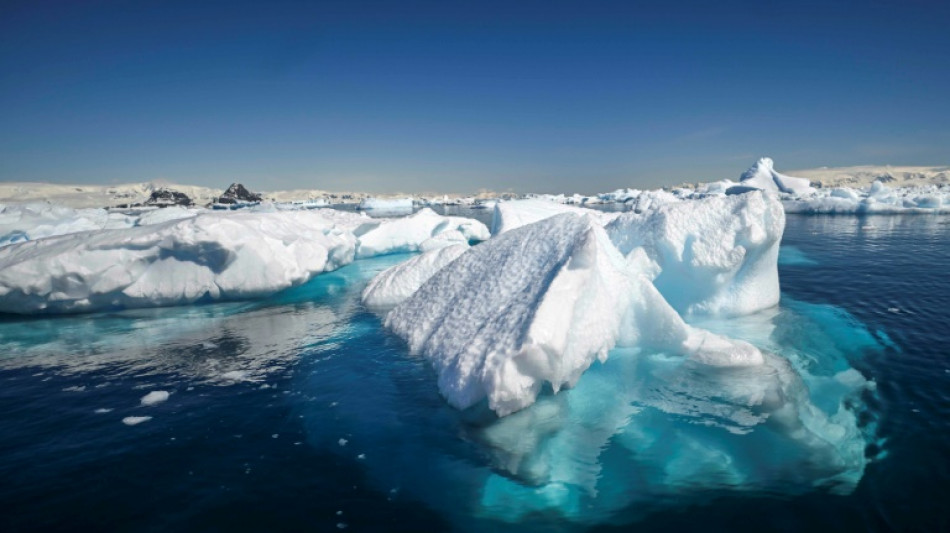
Melting ice could slow vital Antarctic ocean current: study / Photo: © AFP

 Wemby shines on comeback as Spurs stun Thunder, Knicks down Magic

 Wembanyama stars as Spurs stun Thunder to reach NBA Cup final

 Gunman kills two, wounds nine at US university

 Islamabad puts drivers on notice as smog crisis worsens

 Tokyo-bound United plane returns to Washington after engine fails

 Vietnam's 'Sorrow of War' sells out after viral controversy

 For children of deported parents, lonely journeys to a new home

 Chile picks new president with far right candidate the front-runner

 Knicks reach NBA Cup final as Brunson sinks Magic

 Knicks reach NBA Cup final with 132-120 win over Magic

 NBA Cavs center Mobley out 2-4 weeks with left calf strain

 Hawks guard Young poised to resume practice after knee sprain

 Raphinha extends Barca's Liga lead, Atletico bounce back

 Two own goals save Arsenal blushes against Wolves

 Trump vows revenge after troops in Syria killed in alleged IS ambush

 Teenage pair Ndjantou, Mbaye star as PSG beat Metz to go top

 Crime wave propels hard-right candidate toward Chilean presidency

 'Magic' Jalibert guides Bordeaux-Begles past Scarlets

 Anglo-French star Jane Birkin gets name on bridge over Paris canal

 Jalibert masterclass guides Bordeaux-Begles past Scarlets

 Raphinha double stretches Barca's Liga lead in Osasuna win

 Colts activate 44-year-old Rivers for NFL game at Seattle

 Liverpool's Slot says 'no issue to resolve' with Salah after outburst

 Stormers see off La Rochelle, Sale stun Clermont in Champions Cup

 Hungarian protesters demand Orban quits over abuse cases

The world's strongest ocean current could slow as melting Antarctic ice sheets flood it with fresh water, according to research published on Monday that warned of "severe" climate consequences.
Scientists used one of Australia's most powerful supercomputers to model how melting ice sheets might change the Antarctic Circumpolar Current, which plays a major role in global climate patterns.
If fossil fuel emissions increased over the next 25 years -- a so-called high emissions scenario -- the current could slow by around 20 percent, the peer-reviewed research found.
"The ocean is extremely complex and finely balanced," said University of Melbourne scientist Bishakhdatta Gayen.
"If this current 'engine' breaks down, there could be severe consequences, including more climate variability -- with greater extremes in certain regions, and accelerated global warming due to a reduction in the ocean's capacity to act as a carbon sink."
The Antarctic Circumpolar Current acted as a kind of "ocean conveyor belt" shifting immense columns of water through the Indian, Atlantic and Pacific Oceans, Gayen said.
Melting ice sheets would "dump vast quantities of fresh water" into the current, the modelling found.
This would change the ocean's salt content, making it harder for cold water to circulate between the surface and the depths.
Oceans play vital roles as climate regulators and carbon sinks.
Cooler waters can absorb greater amounts of heat from the atmosphere.
The strength of the current -- which flows clockwise around Antarctica -- also acts as a barrier that stops invasive species washing up on the continent's shores.
Algae and molluscs could more easily colonise Antarctica if the current slowed down, the researchers wrote.
Even if global warming was limited to a threshold of 1.5 degrees Celsius, the Antarctic current could still slow down.
"The 2015 Paris Agreement aimed to limit global warming to 1.5 degrees Celsius above pre-industrial levels," said climate scientist and co-author Taimoor Sohail.
"Many scientists agree that we have already reached this 1.5 degree target, and it is likely to get hotter, with flow-on impacts on Antarctic ice melting."
The research team, which included scientists from Australia, India and Norway, noted that their findings contrasted with previous studies that observed the current speeding up.
They said further observation and modelling was needed to understand how the "poorly observed region" was responding to climate change.
The research was published in the Environmental Research Letters journal.
L.Janezki--BTB


